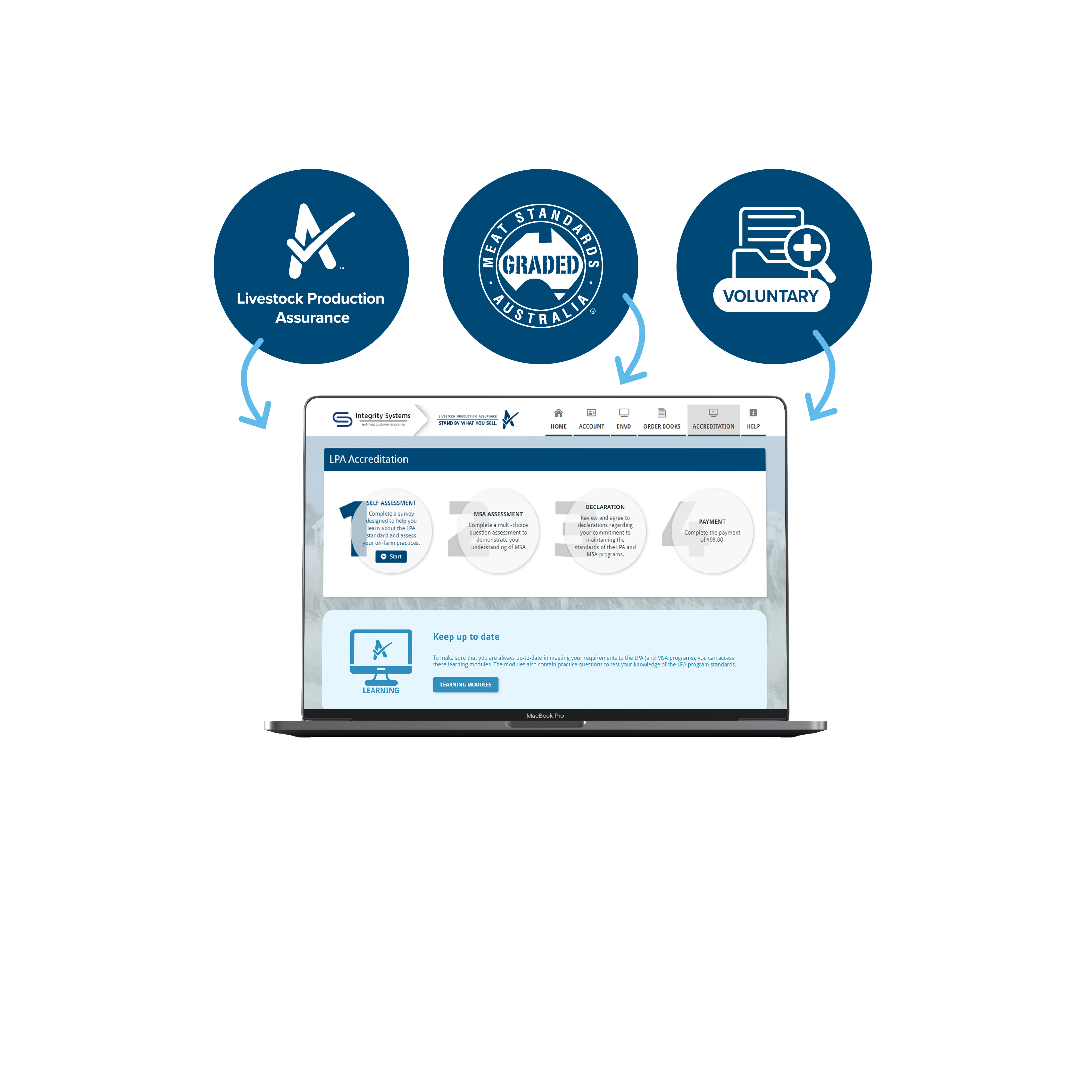
The Self-Assessment tool was launched in September 2024 to simplify gaining Livestock Production Assurance (LPA) program accreditation and reaccreditation and make the process more educational for producers. This change was introduced following an update to the LPA Rules and Standards.

Link your LPA account in your myMLA dashboard for single sign-on use.

Create or upload your On-farm Biosecurity Management Plan, Property Risk Assessment and Animal Welfare Management Plan.
Answer the Self-Assessment questions – there are no wrong answers!
Read and agree to the declaration to confirm your commitment to the LPA program.
Pay the accreditation fee and receive your LPA accreditation certificate.
Download your personalised Recommendations Report.
Continue to access LPA NVDs and eNVDs to buy, sell and move livestock.
Renew your LPA accreditation every two years and keep up to date with LPA requirements.

Answer questions that relate specifically to your farm business.
Benefit from a customised learning experience to help you better understand LPA requirements and how they relate to your on-farm operations.
Download your personalised Recommendations Report and use it to guide on-farm activities to better meet LPA requirements.
Completing the Self-Assessment every two years allows you to gain a variety of accreditations at once. These include the Livestock Production Assurance (LPA) program’s mandatory and voluntary modules, which are optional and depend on your farm operation and credential requirements. Accreditation with the Meat Standards Australia (MSA) program can also be gained through the Self-Assessment tool.
No. LPA does not prohibit or restrict the installation of equipment including solar panels, electrical transformers, capacitors, hydraulic equipment, coal seam gas structures or wind turbines on land which is also used for livestock production and grazing.
For more information please read this guide: Renewable Energy Infrastructure on Livestock Properties
While it is safe for livestock to graze in a paddock which also contains solar panels, wind turbines or other equipment producers need to be aware of the potential risk of contamination as equipment degrades or reaches end of life.
On 1 September 2024, ISC updated the LPA accreditation and reaccreditation process. This included adding a question to prompt producers to consider the potential contamination risk of having equipment and infrastructure installed where livestock graze.
The updated guidance in the Self-Assessment and the Recommendations Report, which is downloadable after completing the assessment, is designed to assist producers in identifying these potential risks and prompt them to consider any risk mitigation that may be required.
As part of LPA accreditation or reaccreditation, producers are required to complete a Property Risk Assessment. This assessment is one component of the LPA program which is designed to ensure Australian red meat remains safe to eat. This Property Risk Assessment template is a useful resource for completing this part of the accreditation.
For more information please read this guide: Renewable Energy Infrastructure on Livestock Properties
You can complete reaccreditation up to 6 months before your renewal due date. Your LPA account will provide a notification 6 months prior to your accreditation due date on the homepage. ISC will also send an email, SMS or letter to you before your LPA renewal due date to remind you that your accreditation is due for renewal. The notification will outline the steps to renew your accreditation.
LPA Learning is available on demand if you or your staff would like a refresher on the LPA requirements before completing the self-assessment.
On-farm Biosecurity Management Plans have been a requirement of the Livestock Production Assurance (LPA) program since 2017, and many producers already have one in place. From 1 September 2026, it became mandatory to upload that plan, or create one, during the Livestock Production Assurance (LPA) program accreditation or reaccreditation process. Having a documented biosecurity plan loaded into your LPA account proves that strong biosecurity measures are active on your property, providing another layer of protection against disease risk.
It also reinforces the credibility of Australian red meat by giving auditors and trading partners confidence that biosecurity risks are being actively managed.
There are no wrong answers. Answers are used to determine what guidance and resources are provided in a producer’s customised Recommendation Report.
Pick whichever answer is closest. Some questions have options for No or Unsure. There are no wrong answers. You can provide feedback at the end if you like so we can improve the Self-Assessment.
On average, it takes less than an hour to complete the LPA Self-Assessment questions. Giving yourself 1–2 hours should allow enough time to log in, read the questions carefully, and complete it in one go.
If you don’t have time to complete it in one go, your answers will be saved and you can come back later to continue where you left off.
You will be able to access the Self-Assessment when completing your LPA accreditation for the first time or when renewing your LPA accreditation. Self-Assessment is the first step in the LPA accreditation and reaccreditation process.
From 1 September 2024, the Self-Assessment will be the method for completing LPA accreditation. This is for producers completing the accreditation for the first time or renewing their accreditation.
Click here for a step by step guide to access the Self-Assessment.
The LPA Rules and Standards are being updated to improve the assurance the program provides. A key change for producers when completing a new accreditation or renewing accreditation is the multiple-choice assessment will be replaced with a Self-Assessment. The update also makes it quicker and easier to complete accreditation.