Search tips
- Check your spelling
- Try a different term
- Keep your search term short and simple
The EW status helps monitor and manage food safety and biosecurity risk along the entire supply chain. It gives livestock buyers and agents a heads up around potential risk by flagging that the PIC may have high risk animals (ie chemical residue or disease) associated with it. The buyer or agent is then able to contact the vendor and seek more information about whether a high-risk animal is in a consignment.
All LPA accredited producers – from large scale operators to hobby farmers – may be audited to check how records are maintained and how food safety, biosecurity and animal welfare management is being carried out on-farm. Help your clients be prepared by sharing the resources below: more information about LPA audits the LPA audit checklist factsheet: how to respond to an LPA Corrective Action Request (CAR) factsheet: how to submit evidence for a remote audit.
As spring marking season approaches, increased pain relief products become available and biosecurity threats converge, livestock producers accredited through Livestock Production Assurance (LPA) are being urged to brush up on their knowledge of safe and responsible administration of animal treatments and record keeping.

You can provide buyers with details of any high risk animals in the consignment, or provide a list of the NLIS tag numbers of each animal in the consignment prior to sale so that they can check if there are any statuses attached to them. You will also provide buyers with the assurances they require by accurately completing the NVD and declaring any livestock that may pose a food safety or biosecurity risk.
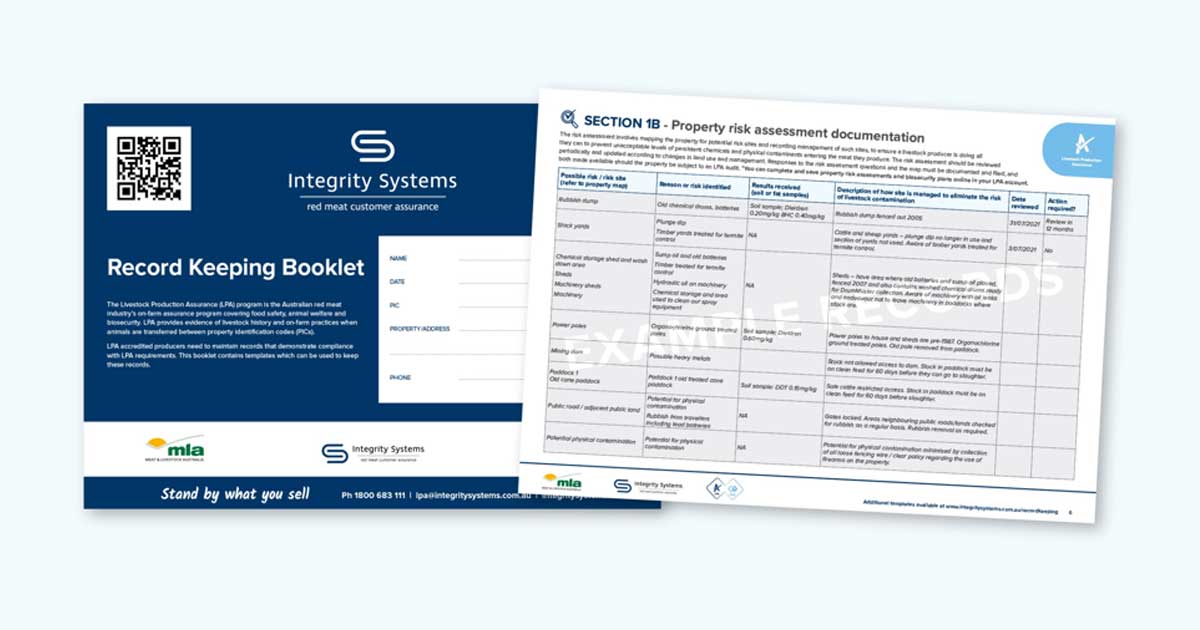
A map of the property identifying any contamination risks. It can also be used to for biosecurity risk management. The location of old batteries, old dip sites, farm rubbish tips, old painted timbers, commercial painted surfaces, machinery, chemical storage or disposal areas, land treated with recycled water and land which shares a boundary with public land (e.g., roadways. railways. state forest. national park) should be highlighted on the map. This will ensure a livestock producer is doing all they can to prevent livestock becoming contaminated and ensure the resulting meat they produce is safe to eat.
An individual animal is given a ‘device-based status’ against its NLIS tag or bolus when it has a known disease or residue issue that presents a food safety or biosecurity risk and requires specific management on-farm, or at feedlots, saleyards and processors. Depending on the risk, the status is assigned by the Commonwealth or State Department, a vet or the Integrity System Company via the NLIS database. The producer is then informed. These device-based statuses automatically trigger an EW status on the PIC where the animal resides in the NLIS database. The device-based statuses that trigger the EW status are:...
Good records and systems are the foundation of the integrity system. Find out more and download ISC’s range of free record keeping templates here.
ISC Scholarship provides opportunity for Tasmanian meat judge

Do you employ farm staff or are you a farm manager? Here’s what you need to do to ensure integrity requirements are met on your property.