Supporting producers in the transition to non-mulesed sheep
29 March 2026 | 4-Min Read
Livestock health and wellbeing is fundamental to the success and sustainability of every farm - it’s also critical to upholding Australia’s high standards of food safety and quality.
Animal welfare responsibilities
The Livestock Production Assurance (LPA) Standards require Accredited Producers to have access to and undertake training on the Australian Animal Welfare Standards and Guidelines.
LPA accredited producers are required to implement on-farm systems consistent with the Australian Animal Welfare Standards and Guidelines, so our domestic and international consumers are assured that livestock is cared for humanely and ethically. This is the basis for the Animal Welfare Management Plan (AWMP) completed during the LPA self-assessment. The AWMP is provided to help livestock producers demonstrate their commitment to animal welfare standards. It allows producers to document their on-farm practices and explain how they meet the relevant animal welfare standards.
To ensure the handling of livestock is consistent with the AWMP requirements for LPA and the Australian Animal Welfare Standards and Guidelines for cattle, sheep and goats (as applicable), livestock producers are required to:
- keep a current copy of the ‘Australian Animal Welfare Standards and Guidelines’ for sheep
- ensure the PIC representative or person responsible for the management of livestock has successfully completed training in relation to the Australian Animal Welfare Standards and Guidelines
- ensure staff involved in animal husbandry are familiar with the content of the current version of the Standards and Guidelines for sheep.
- Complete the AWMP in LPA or during reaccreditation as part of Self assessment
ISC produces an Animal Welfare factsheet that serves as a good overview of what you need to do, and how.
Best practice recommendations
The Standards and Guidelines for sheep cover producers’ responsibilities across a range of animal welfare issues such as tail docking and castration and intensive sheep production systems.
It also looks at specific best practice approaches to sheep mulesing.
Where mulesing is necessary for the long-term welfare of the animal, the guidance says that the mulesing process must be performed in a way that minimises its impact on the sheep.
This includes:
- ensuring it is carried out by a person with relevant knowledge, experience and skills
- only removing wool-bearing skin
- using good hygiene practices
- using appropriate pain relief, particularly for sheep between 6-12 months (pain relief is mandatory in Victoria and recommended in all other states and territories)
- planning mulesing times appropriately for weather and location
- not mulesing sheep which are:
- less than 24 hours old or more than 12 months old
- weak or diseased.
Alternative options for breech strike prevention should be considered before undertaking mulesing, including:
- selecting for resistant conformation
- culling susceptible sheep
- clips
- crutching
- chemicals for flystrike prevention
- internal parasite control.
Transitioning to non-mulesed sheep
An MLA-funded Producer Demonstration Site (PDS) which supported sheep producers to transition to non-mulesed flocks has delivered improvements to their on-farm productivity.
As part of the ‘Transitioning towards non-mulesed sheep’ PDS, 53 participants in NSW and Victoria used genetic tools and other resources – which were readily available – to develop and initiate their own property-specific transition plans. Read more about the solutions explored below.
PDS facilitator Lisa Warn said regular meetings between the producers involved were important to guide them through changes to their management and breeding programs that they identified, to enable the transition to non-mulesed flocks.
“We were aware that while there was a large number of producers who wanted to cease mulesing, they often reported lacking the confidence to do so,” she said.
“Many were fearful of not being able to manage without mulesing as they were worried non-mulesed sheep would be more difficult to crutch – particularly if they were wrinkly or daggy.
“Others were concerned that they may need to use more chemicals to prevent breech strike - leading to possible chemical resistance from flies.
“We felt a group environment where participants could gain support and different insights from their peers who were in the exact same position would really help them along their path to running non-mulesed sheep.”
The producers involved formed four groups based on their geographical location – three in Victoria and one in NSW. These groups were linked to producer advocates operating in a similar environment who had already completed the transition to non-mulesed flocks and could share their experiences.
“This gave participating producers the opportunity to chat with producers who had already completed the transition about what their journey was like, what their key challenges were and how they overcame them.
Participating producers also learnt about a range of tools and resources that were already available to help support their transition goals, including:
- FlyBoss – which enabled producers to review their current flystrike management calendar and analyse how stopping mulesing might impact the timing of their crutching, shearing and any chemical applications
- the Visual Sheep Scores booklet – which enabled producers to assess their flock's flystrike susceptibility, focusing on key indicator traits such as breech cover, wrinkle and dag. This allowed them to identify any changes required in their ram and ewe selection criteria.
- the DNA flock profile tool – which enabled producers to understand where their flock’s genetic baseline was currently sitting, and what traits they needed to focus on to achieve their goal of a non-mulesed flock.
- the Australian Sheep Breeding Values (ASBVs) - which enabled producers to set up a Ram Team Manager account via RamSelect. This allowed them to benchmark their current rams and use their desired breeding objectives to select new rams that aligned with their transition goals.
Each producer was free to determine which options worked best for their demonstration site, based on the key issues affecting their operation as they transitioned to a non-mulesed flock.
For example, one producer ran a sire evaluation demonstration. They separated rams into two groups: high early breech wrinkle ASBV (EBWR) and low EBWR, which other ASBV trait values being kept as similar as possible between the two sire groups.
Lambs born from sires in the high EBWR group had a breech wrinkle score of 1–5, while the lambs born from the low EBWR sire group had breech scores of 1–3 (see Figure 1).
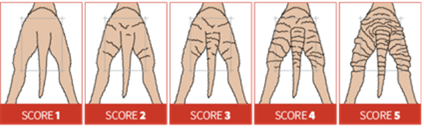
Breech wrinkle scoring chart.
Other producers from different regions in NSW and Victoria trialed smaller non-mulesed lamb mobs, while retaining a larger mulesed mob to observe different management requirements.
These producers found there was little difference between these two mobs in terms of management requirements. The only change noted was that more monitoring may be required for non-mulesed lambs aged up to 18 months.
Additional strategies evaluated by producers included the effects of different tail docking methods to reduce dag. You can read more about this approach on the MLA website.
At the conclusion of the PDS, half the producers involved had made changes to their husbandry procedures calendar, and 70% had made changes to their breeding and selection strategies.
“Transitioning to non-mulesed does not have to be scary,” Lisa said.
“It is essential to understand your starting position in relation to key breech flystrike indicator traits, and set short-, medium- and long-term goals and strategies to work towards.”
“That factor of talking to producer advocates is what builds that confidence to start the journey and engaging with other involved producers along the way is what has then maintained that confidence for many as they have progressed.”