Collecting farmed goat performance data with eIDs
Enterprise snapshot
| Owners: | Sue Diamond and Scott Baker |
| Property name: | Pindari Park Goats |
| Location: | Cadell, Riverland, South Australia |
| Size: | 50 ha |
| Brief enterprise description: | 100 Fullblood and Commercial bred Kalahari Red does mated to Fullblood bred Kalahari Red bucks producing stud and commercial breeders. |
| Number of employees | 1 full time |
| Average annual rainfall: | 250 mm |
| eID data being used: | Weights, animal health and pedigree. |
Background
Pindari Park Goats owners Sue and Scott relocated from Queensland to their Kalahari Red Stud property at Cadell, South Australia, in 2021. They have spent the past three years building herd numbers using their best breeders, selling excess does and bucks, and steadily improving their genetics through careful selection and retention of animals with strong production traits.
Their property consists of dry chenopod shrubland and small areas of arable land on shallow soils. The Riverland’s hot, dry conditions are well suited to the environmental preferences of the Kalahari Red breed. Although their property borders the Murray River, they do not irrigate and instead rely on rainfall for pasture growth, supported by extensive supplementary feeding.
When Sue and Scott relocated to the Riverland, they became interested in using electronic identification (eID) after learning it was likely to become mandatory across the industry. They had already been collecting individual animal data using visual management tags but decided to transition to eID after learning about the potential benefits through Meat & Livestock Australia (MLA) communications. They began applying post-breeder eID tags to both existing and new stock on their Riverland property, allowing them to record and manage data more efficiently for individual animals.
Currently, they use eID tags with management numbers and manually read tag details during data collection. Looking ahead, they plan to invest in a wand or stick reader to significantly speed up the process and further streamline their on-farm data management.
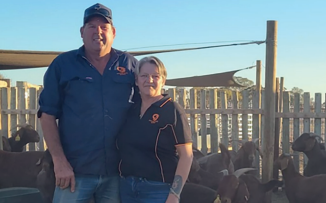
(Scott Baker and Sue Diamond at their Pindari Park Goats property)
What eID supported improvements are Pindari Park Goats looking for?
Scott and Sue want an easier way to record individual animal data for:
- weight gain
- animal health
- genetic pedigree purposes
Data collection and use
The types of eID related data being collected at Pindari Park Goats include:
- weights
- number of kids born (dry, single, multiples)
- ease of birth
- number of kids weaned (success in raising twins and triplets to weaning)
- worm egg count.
Weight data collection occurs at birth, one week, four weeks and then opportunistically during routine management activities to maximise efficiency.
Data on the number of kids born is collected by observation as their number of breeders is small and the proportion of multiple births is high, making pregnancy scanning less important for their operation.
Pregnant does are provided with nutrition levels suited to multiple births. It is acceptable for maiden does to produce a single kid from their first joining, but subsequent joinings are expected to produce twins or triplets.
Where a doe is dry or produces a single kid in subsequent joinings, she is given another breeding opportunity with a different buck. Only after producing multiple single kids or remaining dry across multiple joinings is a doe removed from the herd.
Individual worm egg count data is collected through annual testing.
Currently, all data is entered manually into Excel spreadsheets to create profiles for individual animals. Sue and Scott are in the process of purchasing a wand for collecting and retrieving individual animal data. Their main considerations in selecting the right product are:
- connectivity with the scales they currently use
- easy process to transfer data from scanning device to a computer
- availability of after sales support
- compatibility with a software package that can store pedigree information as well as production-related data.
How will eID technology help achieve their livestock goals?
Sue outlines the main advantage of having eID scanning equipment will be the significant time savings compared to their current manual method of visually reading tag numbers.
Having the ability to more quickly collect and review individual animal weight data will also allow for the earlier identification of emerging animal health issues. his will assist them in making more informed and responsive nutrition management decisions, particularly in the leadup to joining.
The ability to more efficiently collect individual animal data will become increasingly important as they move toward increasing their herd up to 350 breeders.
More Information
To read more case studies highlighting how South Australian producers are benefitting from eID technology and using eID data to drive smarter decisions and greater efficiencies on farm, visit the PIRSA website.
For more information about eIDs, please refer to the Integrity Systems website.
If you need further assistance with the transition to eIDs, please email info@integritysystems.com.au.
Alternatively, you can speak with the Customer Service team on 1800 683 111, Monday to Friday between 8am and 7pm (AEDT) or on weekends between 9am and 5pm (AEDT). You can also access the Chatbot seven days a week via our website or from your myMLA, eNVD (web platform) and LPA account pages.